
I Wrote the Same Essay Topic, one by Hand and one With AI: Which Did my friends prefer? (The answer will shock you!)
What this experiment taught me about the creative process, the memory-making that is in labor and writing and the significance of that to... everything.
By Ada · October 11, 2026 · 6 min read

Note: if you want to participate in the essay poll, you're encouraged to read the essays and pick your preference before you start reading the article.
Even within my work as a fractional COO, I spend a LOT of time writing. Hours are spent every week on emails, my social media, messaging team members, writing out strategy, and prompting AI. My clients also get a lot of me typing away sentences on the computer for the various tasks that end up building their systems for scaling. I think it's time we take a close look at language.
It's perplexing to think about how many versions of writing we do every day. We write to express ideas, communicate decisions, simplify processes, and more. And yes, much to (I'm sure) many of my peers' astonishment, I do still manually write out a lot of my own emails (and READ them too)!
So I decided, how about I carry out an experiment? One topic. Two essays. One written with AI assistance, and one written by hand without it. Then I would ask my friends to read both without knowing which was which and tell me which they preferred.
This blog article, in the spirit of this "scientific experiment," is formatted like one. Of course, if this was really a scientific experiment, variables like agreed essay writing level and sample size would be more rigorous. I'm sure you figured, but just making sure that's clear.
Purpose
Learning and memories are powerful features of human beings because they occur almost every waking second of one's life. You're constantly using your experiences and memories as a way to learn about yourself, your friends, your partners, your family, and the wider world around you. In another blog article, I briefly mentioned friction as a necessary and purposeful part of a significant part of my process in systems and strategy.
That friction is necessary because of the time it takes, such that one is able to create memories and subsequently learn from them. Write the procedure section of your standard operating procedure by hand because you then enmesh yourself deeper and on a more intuitive level to the work that you're writing about.
Such is the same for when you're communicating an idea, defending a decision, explaining a story. You're doing a lot of learning in that moment. And all that learning makes up for a significant amount of the real human decisions you make in marketing strategy, data analysis, brand building, team culture, etc. When you automate even that, the output that happens turns out pretty grisly.
At the same time, in experimenting with AI in my marketing copy for clients, I found the process of reviewing frustrating. Marketing emails, website copy, and copy for social media would get locked in a cycle of reviewing, rephrasing, and meaning-making that would have me realizing in certain instances I probably could have just written it out myself. While I'm by no means a professional writer, I felt that there was something to be said about having a perspective, and a voice even with the time and effort it took.
Now I could have had the actual compared written pieces be a long marketing email or a blog post. Maybe that would have worked too. But an essay in its length, purpose, format, voice and prose is friendly to everyone who has any idea that they want to communicate: the greatest essays often came from poets, authors, scientists, economists who all had interest in their own field and wanted to share a piece of that with the world, and not particularly essayists themselves.
An essay was then the perfect comparison vehicle in that respect. Besides, as Y Combinator founder Paul Graham said in his own 2004 essay, it's The Age of the Essay. All hail the high school essay!
Research question
When I write two essays on the same topic, one with AI assistance and one without, which do readers prefer, and how do the two processes compare in time, effort, feelings when writing, and sense of ownership?
Method
I went on Google to find an essay topic randomizer and was given the topic, "Advancements in technology have made our lives easier, but some people argue that it has also made us more isolated. Discuss both sides and give your opinion." I decided to make this essay a high school essay with 1000 words and limit my vocabulary to those levels as well. For the handwritten essay, I used Google for further research on experts on the topic and references as needed.
This is a process that took me a little under 2 hours. For the AI-written version, I used Perplexity to feed it the exact topic and the word count as a prompt. Then, when reading the output and feeling it had something missing, I gave it two further prompts:
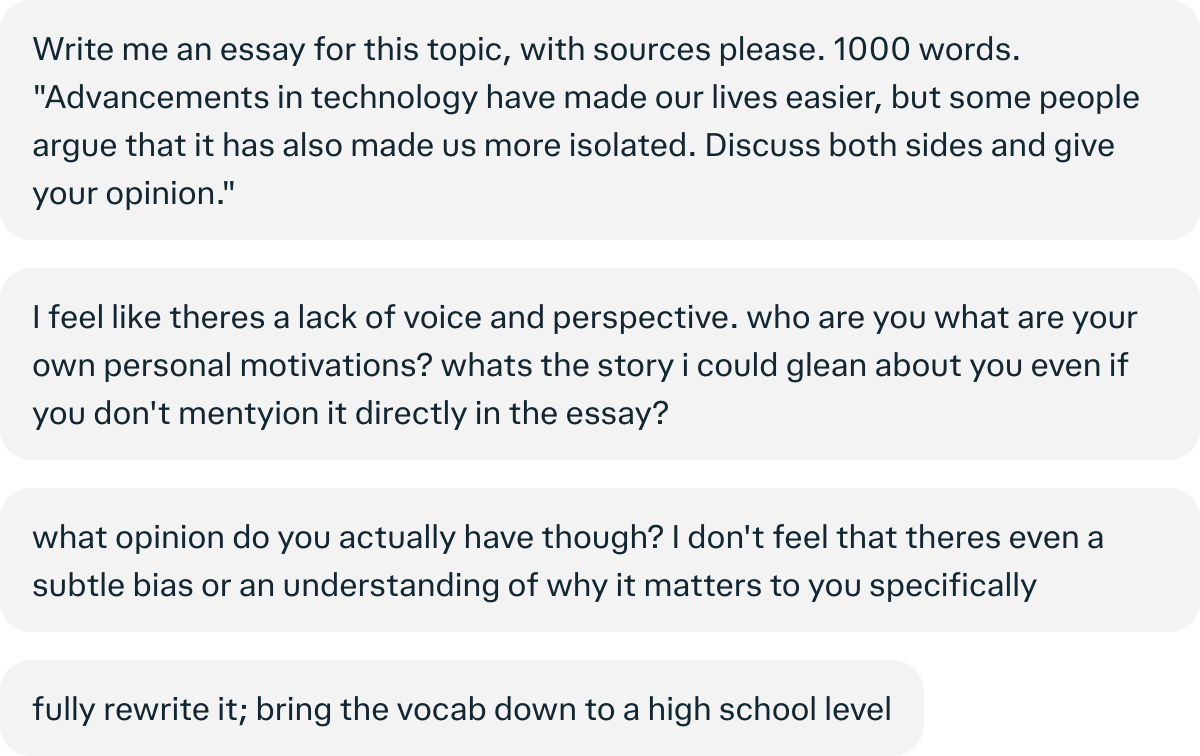
The AI-writing process took me about 30 minutes, after doing research to put my feelings of the vacuity of the AI-written first draft to words and prompt as needed to make the two essays more indiscernible from each other. I made sure to write the handwritten essay first so I couldn't be affected by the reading of the AI essay. Then I presented the essays to my five friends and asked them to simply tell me which one they preferred.
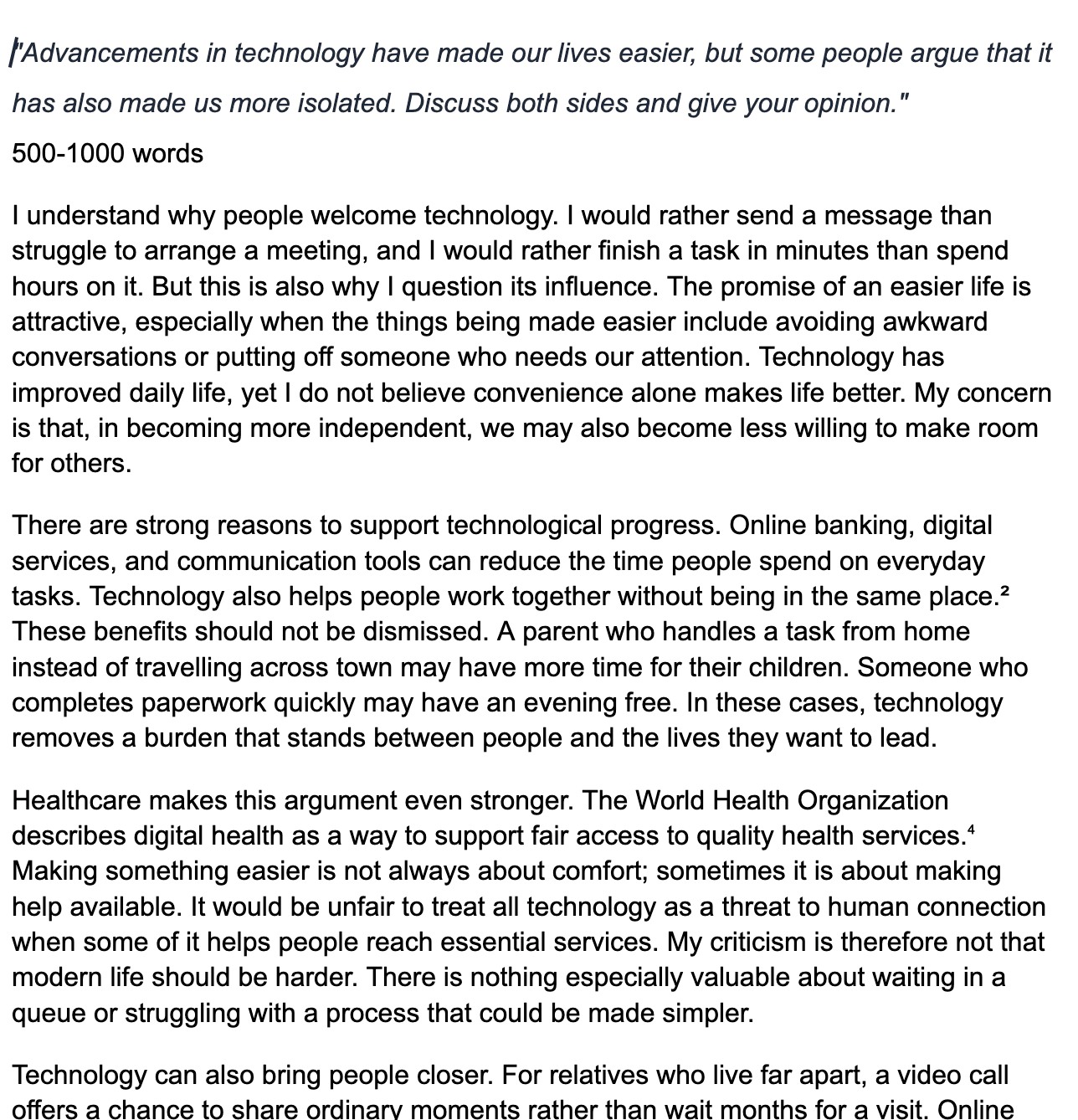 Essay #1
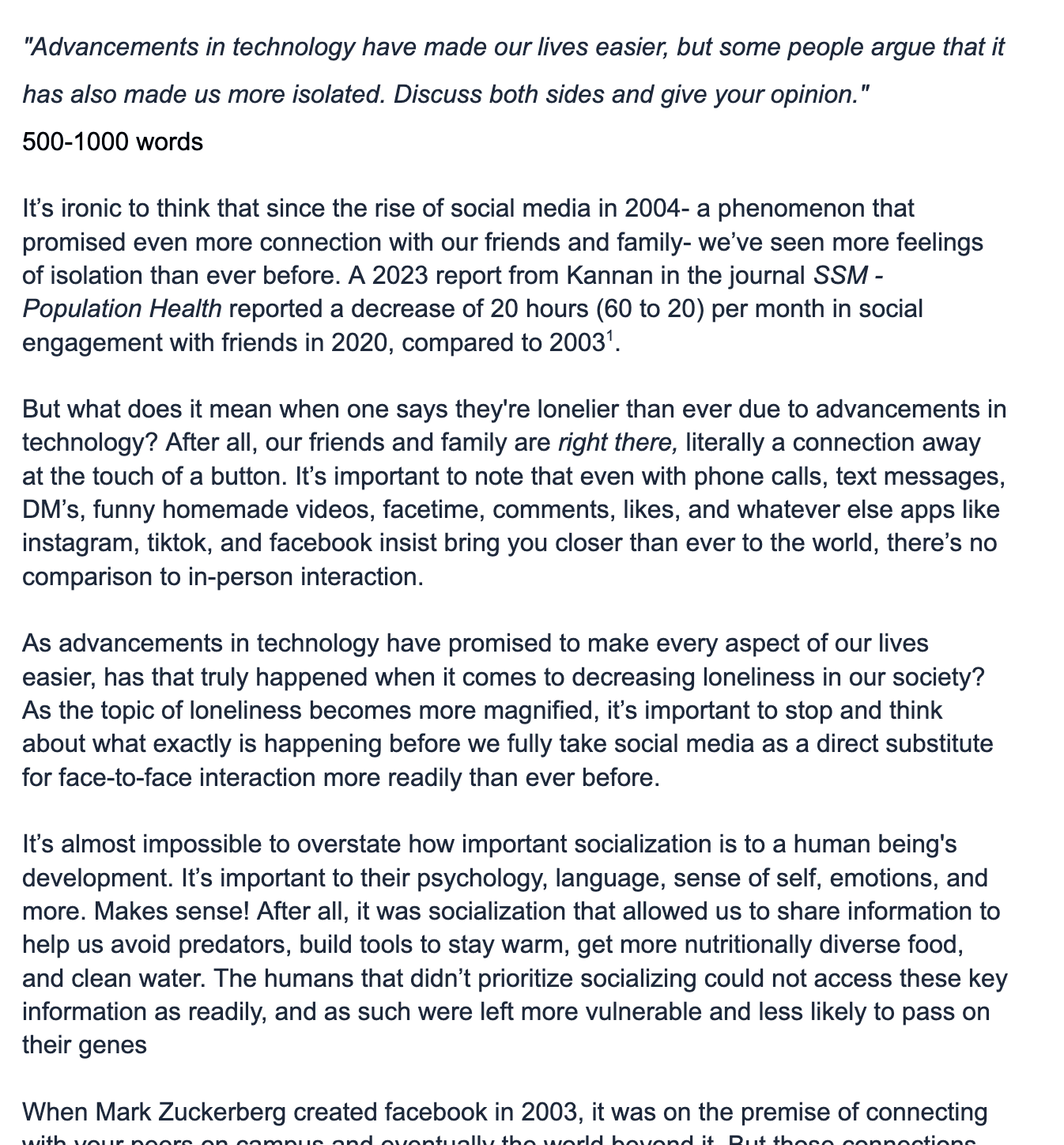 Essay #2
Before you read the results, tell me which one YOU preferred, dear reader:
Results and discussion
Five friends submitted feedback. Of those friends, 3 friends preferred the AI-written essay, and two preferred my own essay. Essay #1 was AI-written, while Essay #2 was written fully by me.
So, does a pseudo-scientific article make a conclusive result? Though I hadn't written an actual proper essay in years (a decade, to be exact) I was surprised how transformative the writing process was. A process that was initially difficult (to be honest I thought the prompt was too vague and not a topic I was personally excited by) became one I was invested in by the end of it.
Though I felt this experiment could probably have been helped by someone who was a more established writer I do like that this was written by someone who is more at the beginning of a dedicated writing journey.
Though obviously it won't make sense to say which one I prefer, I would say the final reading experience of the AI written essay was significantly better than its first draft where I didn't feel the essay a) knew who they were b) cared about writing this essay c) didn't have a noticeable personality or personality that came through and d) didn't have a distinct bias and stake where there was risk taken.
The final draft of the AI-written essay was much better in its voice, and technically perfect, but the overall feeling of reading the essay was boring for lack of a better word. On finishing reading the essay, I didn't feel particularly changed by it emotionally.
Conclusion
At the end of this experiment, I do feel encouraged to write more by hand: because I live, I have a perspective. In the age of AI, and now RSI where the AI is able to "improve" on itself, that advantage is bigger than one might think. This is my fifth fully written blog post (and first "scientific experiment"), and I feel settled by this question that has plagued me. Were you surprised by the results of this experiment? Which essay did you prefer and why? Comment below.
New posts, first
Want the next one the day it goes up?
Leave your name and email and I'll send each new post your way when it's live. Just the blog, nothing else.
Comments